
How to Choose a Reliable Sarong Supplier in Indonesia: A 7-Point Checklist
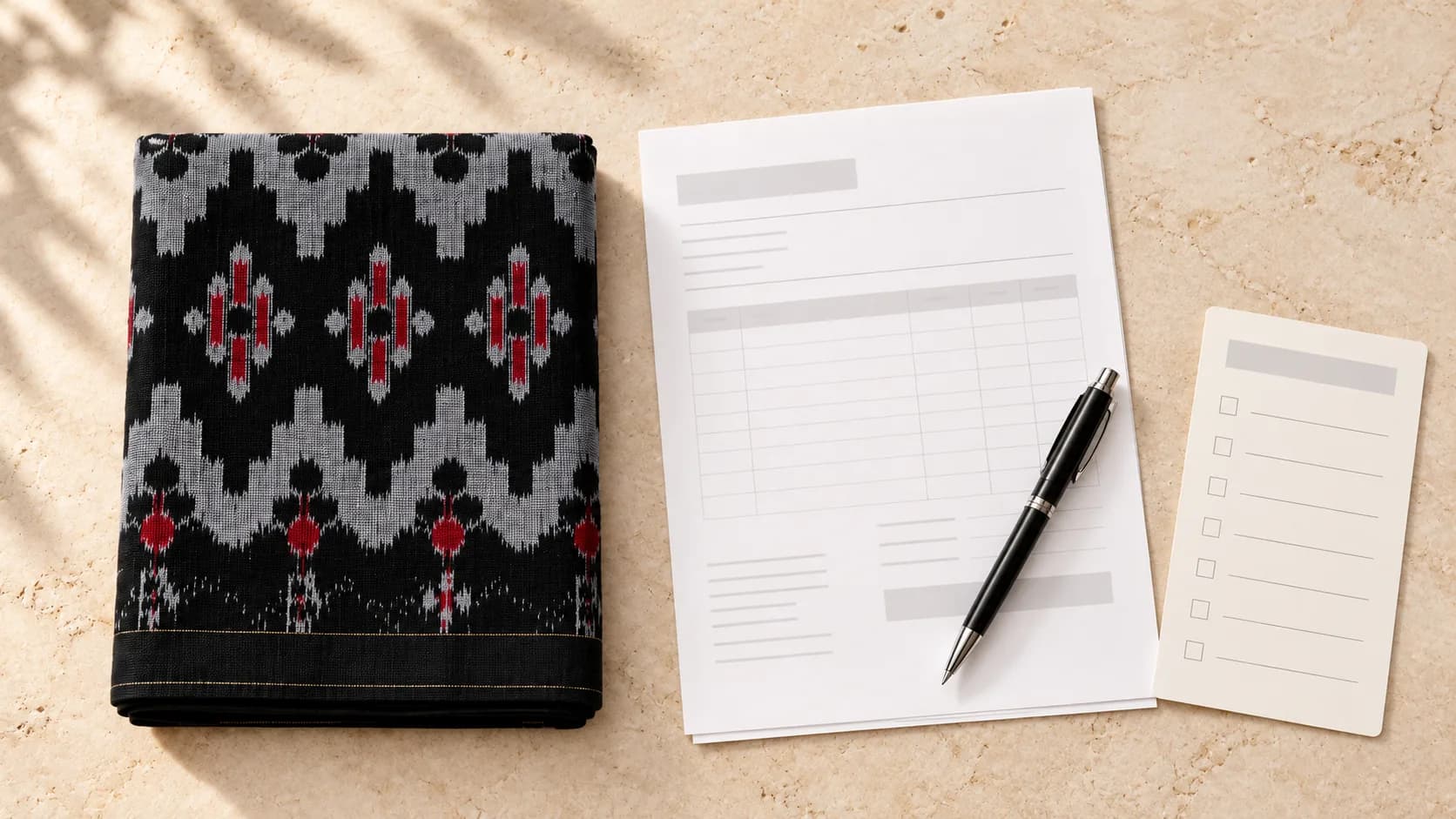
A good sample proves the product. It doesn't prove the business behind it. Buyers lose money when a supplier goes quiet after the deposit, can't repeat a best-selling design, or changes the terms once production has started.
This checklist is for boutiques, distributors and sourcing agents choosing a sarong supplier in Indonesia. It complements our guide to spotting a premium handwoven sarong, which covers the product itself.
1. A business you can verify
Ask for the company's legal name, its business identification number (NIB), its tax ID (NPWP) and its registered address. In Indonesia, the NIB is issued through the government's Online Single Submission (OSS) system, so a legitimate supplier can share it without hesitation.
Check that the name on the quote, the invoice and the bank account all match. A request to pay into a personal account is a warning sign.
2. Who actually weaves the sarongs
Between the loom and your warehouse there may be weavers, a workshop, a trading company and an agent. Each layer adds margin and distance from the people who make the product.
Ask whether the supplier weaves in-house or works with weaving centers, how many looms are involved, and whether you can see the work on a video call. Our sourcing guide lists more questions to ask.
3. Capacity and consistency
A supplier that can make 20 pieces may not be able to make 2,000, or to repeat the same design and colorway six months later. Ask for the monthly capacity, the lead time at your volume, and how colors are kept consistent between batches.
Our guide to bulk sarong orders explains how lead times change with volume. To see how consistency is checked during production, read our guide to sarong quality control for bulk orders.
4. Terms in writing
Before production starts, everything you agreed should be on one proforma invoice: quantity per design, unit price and currency, the Incoterm, lead time, packing and labeling, and the payment schedule. "Goods must match the approved sample" belongs on it too.
Verbal promises are hard to enforce across borders, so treat anything that isn't written down as not agreed. The common Incoterms are explained in our guide to shipping sarongs from Indonesia.
5. Payment you can trace
A deposit followed by the balance before shipment is a common structure for handmade goods. Pay by bank transfer to the company account named on the invoice, and keep every transfer record.
Be cautious of unusually large deposits, or pressure to pay before the terms are written down.
6. References and track record
Ask how long the supplier has been trading, which markets it ships to, and whether a current buyer would be willing to speak with you. Reviews, testimonials and a consistent online presence help, but a short call with an existing customer tells you more.
7. After-sales commitments
Find out in writing what happens if pieces arrive damaged or don't match the sample: replacement, credit or return, and within what time. Ask who pays for samples, and how custom orders are treated, since they are often non-returnable.
How Heritage Loom answers the checklist
We hold ourselves to the same checklist:
- Registration: Heritage Loom is operated by PT Hutama Heritage Indonesia, registered for the wholesale of textiles. Our NIB, NPWP and registered address are listed on our Imprint page.
- How it is made: our About page walks through each stage, from selecting materials to the final quality check.
- Capacity: orders under 5 kodi are processed in 7 business days, and larger or custom orders are scheduled per order.
- Written terms: every order starts with a quotation covering wholesale pricing, lead time and packing details.
- Payment: a 50% deposit starts production, and the balance is due before shipment.
- After-sales: ready designs can be returned within 5 business days of receipt if unused, unwashed and in their original packaging. Custom orders can't be returned, and we cover half of the sample shipping cost. The details are in our shipping and returns policy.
Start with a conversation
Send your requirements through our Contact page, and ask us anything on this checklist. Our team will reply on WhatsApp, or you can reach us by phone or email.
More Stories

How to Wash and Care for a Handwoven Sarong: A Guide Retailers Can Share with Customers
Handwoven cotton sarongs last for years with simple care. This guide explains how to wash a sarong, from the first wash to drying, ironing and storage, and how to treat spots without fading the colors or straining the weave. It also covers how retailers can keep stock in good condition, and ends with a short care card to share with customers.

Wholesale Sarongs for Resellers: How to Order, Minimum Quantities and Tips
A practical guide for resellers buying handwoven sarongs wholesale: the minimum quantity, how ordering works from choosing designs to delivery, and how to plan a first order that sells through. At Heritage Loom, the minimum order is 1 kodi (20 pieces), ready designs can be mixed, and wholesale discounts grow with the number of kodi. The guide also covers the deposit, processing time, returns and tips for reselling handwoven sarongs.

B2B Sarong Sourcing: How Heritage Loom Ensures Quality Control for Bulk Orders
Handwoven sarongs are never identical, so quality control for a bulk order has to separate natural variation from real defects. This guide explains what is checked at each stage of a bulk order, from the approved sample and dye batches to the final check before packing, which defects buyers look for, and what to agree in writing, including tolerances, defect classes and AQL sampling. It also shows how Heritage Loom handles quality control and how to order in bulk in four steps.