
The Ultimate Sourcing Guide: How to Import Indonesian Handwoven Sarongs to Malaysia, Brunei & Singapore

Demand for authentic Indonesian handwoven sarongs is steady across Malaysia, Brunei and Singapore: in retail boutiques, in modest fashion, and in corporate gifting that peaks before Ramadan and Hari Raya. What separates a profitable first order from an expensive lesson is rarely the design. It is the sourcing.
Buying wholesale handwoven sarongs means buying a handmade product, in bulk, from another country. Quality varies between weavers, terms vary between suppliers, and a shipment can sit at the border over a single missing document. This guide covers what to verify, what to agree in writing, and what to prepare before your first order leaves Indonesia.
1. Know what you are buying: handwoven or machine-made
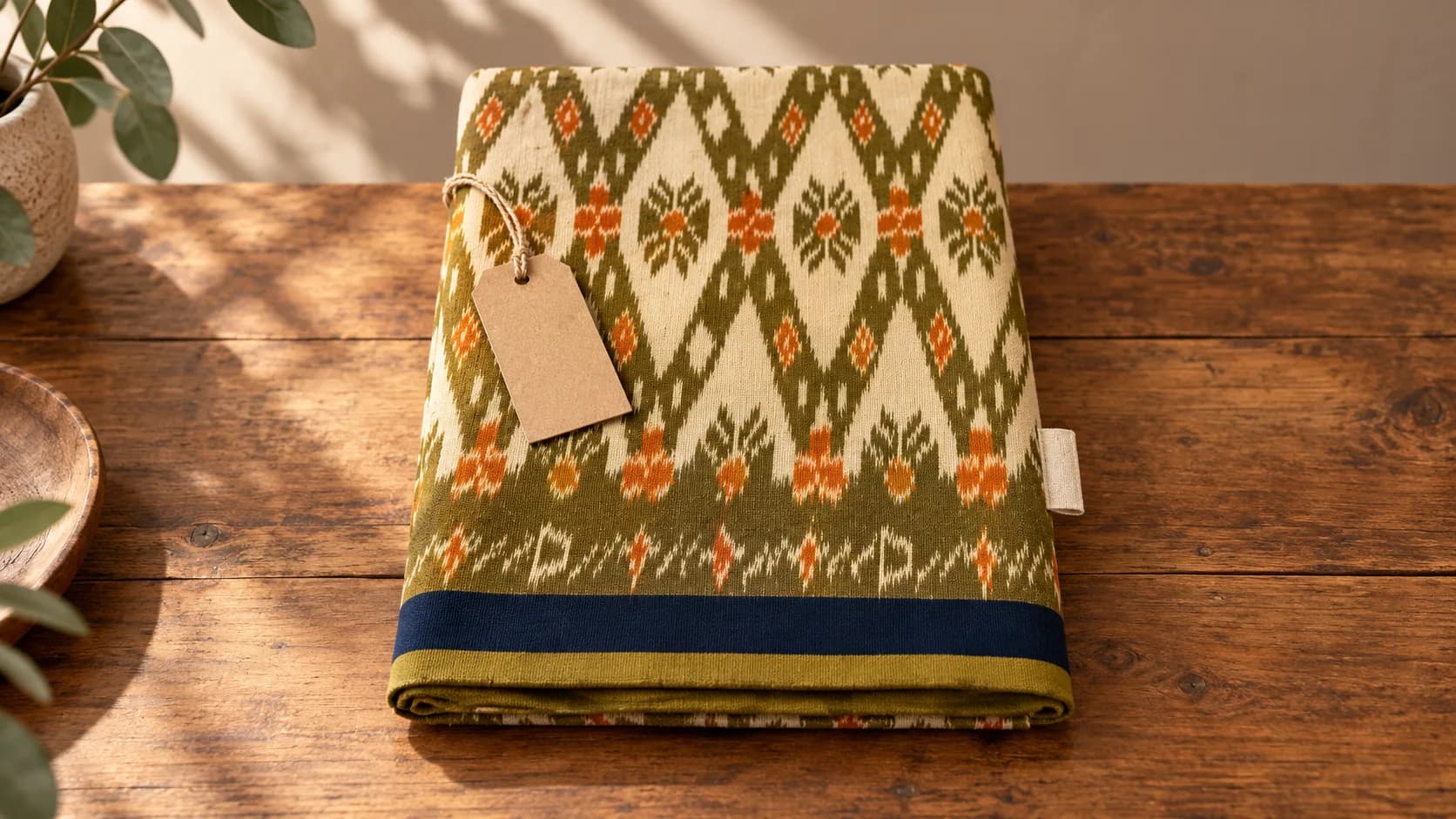
Indonesian sarongs offered at wholesale fall into two very different groups. One is woven on a hand loom, known locally as ATBM (alat tenun bukan mesin), where a weaver passes every thread by hand. The other is produced on a power loom at a fraction of the labour cost.
You can usually tell them apart in a sample:
- Handwoven pieces carry small, honest irregularities in the motif, a denser and heavier hand, and — on ikat designs — soft, feathered pattern edges, because the yarn is tie-dyed before it is ever woven.
- Machine-made pieces repeat perfectly, feel lighter, and often show sharply printed rather than woven motifs.
Neither is wrong, but they are different products at different price points, and your customers will eventually notice which one they bought. For six practical checks, see our guide to handwoven vs. machine-made sarongs. Put it in writing at the quotation stage, together with the material and the finished size. Heritage Loom's ready collections, for example, are woven in cotton at 120 × 125 cm, and each design is listed with its full specification in the catalog.
If you are new to judging woven quality, start with our guide on how to choose premium handwoven sarongs, then come back to the commercial questions below.
2. Check who you are actually buying from
Between the loom and your warehouse there can be a weaver, a producer, a trading company and an agent. Every layer adds a margin and a little more distance from the people who make the product. Before you discuss price, find out where your supplier sits.
Useful questions to ask early:
- Do you weave in-house or subcontract to a weaving village, and how many looms are involved?
- Can we see the workshop on a video call before we order?
- Can you reproduce this exact design and colourway again in six months? Repeatability matters more in retail than it does for a one-off purchase.
- Who owns the design? Ask explicitly if you plan to sell it as your own line.
Confirm the basics of the business too: a registered company, a bank account in the company's name, and a physical address you can verify. Heritage Loom's office address is listed on the contact page, and the story behind the collections is on the about page.
Be cautious with a quotation far below everyone else's. Handwoven has a price floor set by human labour; a number well under it usually means a power loom, a thinner yarn, or a shortcut in the dyeing.
Our 7-point checklist for choosing a reliable sarong supplier goes further.
3. Order samples before the bulk order
A sample is the cheapest insurance in this trade. Photographs cannot tell you the weight of the cloth, how the fringe is finished, or whether the colour survives a wash.
When the sample arrives:
- Wash one piece exactly as your customer would, then compare it against an unwashed one for shrinkage and colour loss.
- Rub the dyed area with a damp white cloth to check colourfastness.
- Measure it. A sarong that is 5 cm short of the stated size is a complaint waiting to happen.
- Check the selvedge and the finishing on both ends, which is where rushed production shows first.
Agree who pays for the sample and its shipping before you ask. Heritage Loom splits sample shipping 50:50 with the buyer, as set out in the shipping and returns policy.
Keep the approved sample. It becomes the quality reference for the bulk order, and "the shipment must match the approved sample" is a far more useful line in a purchase order than "good quality".
4. Agree MOQ, price and lead time in writing
The Indonesian textile trade counts in kodi: one kodi is 20 pieces. Minimum order quantities are quoted the same way, so ask for the MOQ per design rather than per order. At Heritage Loom, ready designs start from 1 kodi in total, and you can mix motifs as long as the total comes in whole kodi; custom designs are ordered in whole kodi per design.
Settle these points before production starts, in one proforma invoice:
- Quantities per design, unit price and currency.
- Payment terms. A 50% deposit to start production with the balance due before shipment is the common structure, and it is the one Heritage Loom works with. Expect the deposit to be non-refundable if you cancel.
- Lead time. At Heritage Loom, orders under 5 kodi (100 pieces) take 7 business days; 5 kodi or more is agreed per order; custom production is confirmed against your specification. Shipping time sits on top of all of these.
- Packaging, labelling and the Incoterm (see below).
Count backwards from your selling season. For a Ramadan or Hari Raya range, production, sea freight and customs clearance together can easily take two months before the goods reach your shelves.
For a closer look at what drives the price per piece, see our guide to bulk sarong orders.
5. Plan the shipment before you place the order
Sarongs are light but bulky, so the shipping method is decided by volume, not weight. Heritage Loom packs 100 pieces to a carton measuring 44 × 36 × 83 cm at roughly 50 kg; a 20 ft container takes about 213 cartons and a 40 ft container about 516.
For Malaysia, Brunei and Singapore that usually means:
- A first or trial order of a few kodi travels best by air freight or express courier. It clears in days rather than weeks, and the freight cost per piece is still modest at that size.
- Repeat orders in the tens of kodi are worth consolidating into sea freight, LCL or a full container, once the landed cost per piece justifies the extra transit time.
Agree the Incoterm explicitly: EXW leaves everything to you from the workshop door, FOB hands the goods over at an Indonesian port, and CIF or DDP shifts more of the arrangement to the seller. Whatever you choose, import duties and destination taxes are the importer's cost unless you have agreed otherwise in writing.
For export documents, packing and lead times in one place, read our guide to shipping sarongs from Indonesia.
6. Get the customs paperwork right
Most delays at an ASEAN border are documentary, not physical. For a textile consignment you will normally need a commercial invoice, a packing list, and a bill of lading or air waybill — plus two things that are easy to overlook.
Certificate of Origin (Form D)
Form D is the ASEAN Trade in Goods Agreement certificate that lets an importer claim preferential — frequently zero — duty on goods originating in another ASEAN member state. Indonesia issues it electronically, and the e-Form D is exchanged between member states through the ASEAN Single Window, so your broker can clear the consignment against a reference number instead of waiting for a paper original.
Ask your supplier whether they can issue a Form D for your shipment before you pay a deposit. Not every small workshop is set up to apply for one, and without it you pay the ordinary duty rate.
HS code and classification
Agree the HS code up front with your forwarder or customs broker. A sarong can be classified as woven fabric or as a made-up garment depending on how it is finished, and that classification decides the duty rate, the documents required and whether any import permit applies. Getting it settled before the goods ship is far cheaper than arguing it at the port.
Check the destination's labelling rules as well — fibre content and a country-of-origin marking on the product and on the carton.
7. What to expect at each border
Singapore. As a free port, Singapore levies customs or excise duty on only four categories of goods: intoxicating liquors, tobacco products, motor vehicles and petroleum products. Textiles are not among them, so sarongs enter duty-free and the main cost is GST on the CIF value, at the prevailing rate — 9% since January 2024. Declarations are filed through TradeNet, usually by a declaring agent.
Malaysia. Import duty may apply depending on the classification, alongside sales tax under the SST regime. This is precisely where a valid Form D earns its keep, by bringing the duty on Indonesian-origin goods down to the ATIGA preferential rate. Rates and the sales tax scope have changed more than once in recent years, so confirm both with the Royal Malaysian Customs Department or your broker rather than relying on last year's figures.
Brunei. There is no GST or VAT, but customs duty depends on classification, and declarations go through the Brunei Darussalam National Single Window. Confirm the applicable rate with the Royal Customs and Excise Department before you commit to a landed-cost calculation.
Stocking a shop in Malaysia or Brunei? Our first-order guide for Malaysian and Bruneian shops covers designs, minimums and shipping.
In all three markets the classification, not the country, decides what you pay. Have it confirmed in writing before the goods leave Indonesia.
Importing into Thailand instead? Our Thailand import guide covers Thai Customs registration, VAT and Thai labels.
8. Consider custom and private label once a design sells
A design that moves quickly on your shelf will be copied. Exclusive motifs and your own branding are what protect the margin on a repeat order, and both are ordinary requests at this scale.
Custom production lets you set the motif, the colourway, the size and the material, and add your own woven label, hangtag and packaging. Two practical notes: production time is confirmed against your specification rather than the standard schedule, and custom pieces are not returnable — so approve a physical sample before the full run. You can see what the service covers on the Heritage Custom page. Our guide to custom sarong manufacturing explains MOQ, production steps and lead times. For the steps from the branding brief to launch, see our guide to private label sarongs.
9. Placing your first order with Heritage Loom
The process is deliberately short:
- Browse the catalog and note the designs and the quantity in kodi you want for each.
- Send your enquiry through the contact page or the enquiry cart; it reaches our team on WhatsApp.
- Receive a quotation covering wholesale pricing, lead time and packing details.
- Approve a sample, then confirm the order with the 50% deposit.
- Production runs, the balance is settled, and the goods ship with the documents your broker needs.
Sourcing handwoven sarongs for a boutique, a distribution business or a corporate gifting programme in Malaysia, Brunei or Singapore? Tell us what you are planning and we will send wholesale pricing and availability for the designs you are interested in.
More Stories
Private Label Sarongs: How to Launch Your Own Sarong Line with an Indonesian Manufacturer
Private label sarongs let a boutique, distributor or brand sell handwoven sarongs under its own name. This guide explains how ready designs, custom designs and private label differ, when it makes sense to start, and five steps to launch your own line: defining the designs, briefing labels and packaging, approving a sample, planning quantities and timing, and reordering. At Heritage Loom, custom designs start from 1 kodi (20 pieces) per design, with the option of your own logo, labels and packaging.

How to Wash and Care for a Handwoven Sarong: A Guide Retailers Can Share with Customers
Handwoven cotton sarongs last for years with simple care. This guide explains how to wash a sarong, from the first wash to drying, ironing and storage, and how to treat spots without fading the colors or straining the weave. It also covers how retailers can keep stock in good condition, and ends with a short care card to share with customers.

Wholesale Sarongs for Resellers: How to Order, Minimum Quantities and Tips
A practical guide for resellers buying handwoven sarongs wholesale: the minimum quantity, how ordering works from choosing designs to delivery, and how to plan a first order that sells through. At Heritage Loom, the minimum order is 1 kodi (20 pieces), ready designs can be mixed, and wholesale discounts grow with the number of kodi. The guide also covers the deposit, processing time, returns and tips for reselling handwoven sarongs.