
B2B Handwoven Textile Supplier: Getting to Know Jepara Ikat Sarongs for Wholesale and Export

Finding a B2B handwoven textile supplier is different from buying a piece of cloth in a shop. Business buyers need clear minimum quantities, wholesale pricing, production schedules and shipping that works, often across borders.
This guide introduces Jepara ikat sarongs as a wholesale and export product, explains the order options a B2B supplier usually offers, and lists what to confirm before you pay a deposit. The examples use Heritage Loom's current terms.
What a B2B handwoven textile supplier does
A B2B supplier sells to businesses rather than end consumers: boutiques, resellers, distributors, importers and companies ordering gifts. What sets it apart from a retail seller:
- Wholesale pricing and minimums. Prices are per piece, there is a minimum order, and discounts grow with the order size.
- Made-to-order production. Besides stock that ships right away, the supplier takes pre-orders and custom designs with an agreed production time.
- Quality standards for the whole order. Every piece is checked against an agreed reference, not just one sample.
- Shipping readiness. Goods are packed by the carton and shipped with the documents the destination requires.
Getting to know Jepara ikat sarongs
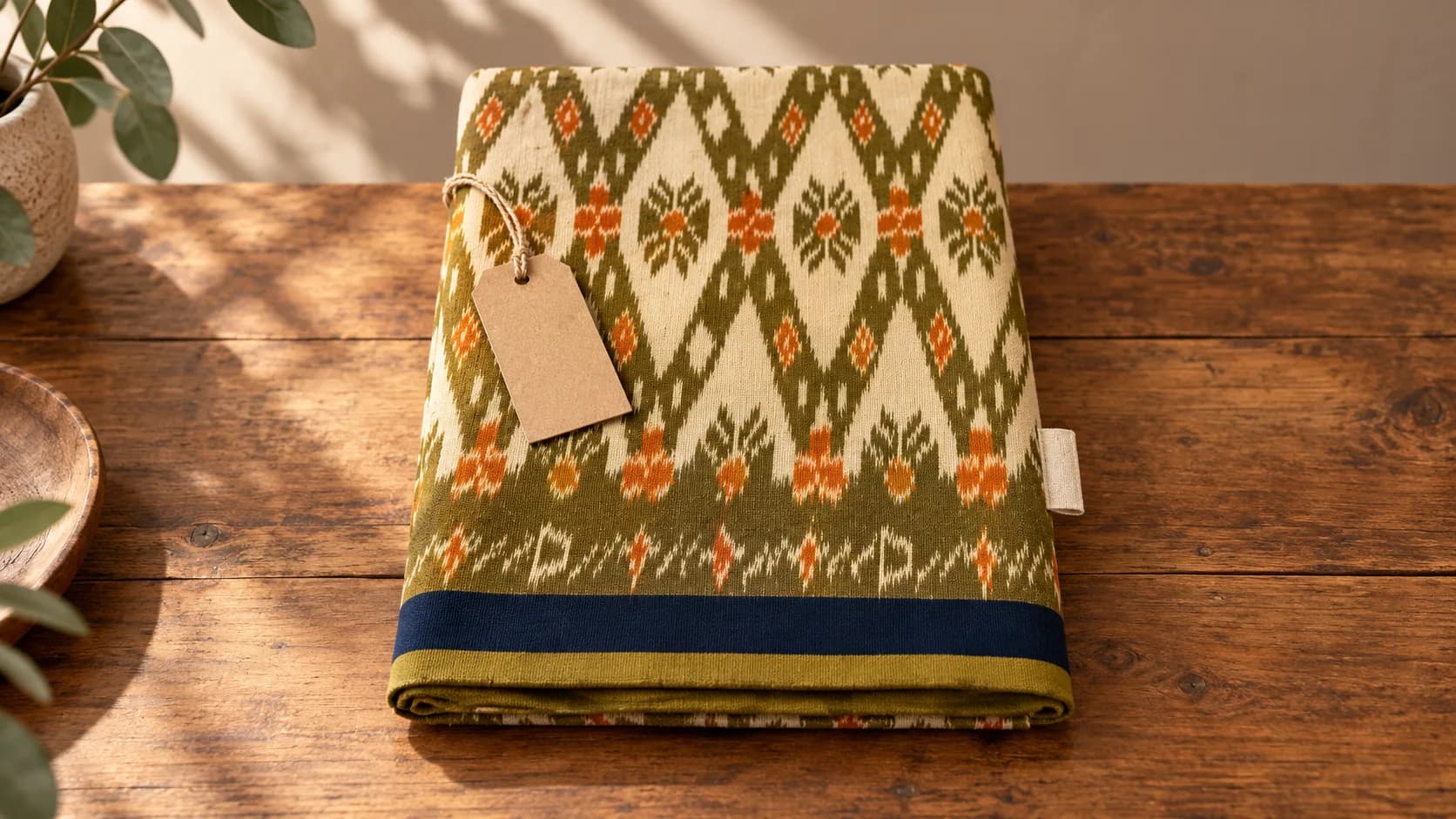
Ikat is a weaving technique in which the pattern is created before the cloth is woven. Sections of yarn are tied according to the design and then dyed, so the tied parts resist the color. Once the ties are removed, the yarn is woven and the pattern appears in the cloth.
In Jepara, Central Java, the center of ikat weaving is Troso village in Pecangaan district, which is why the cloth is known as tenun Troso. It is woven on ATBM looms (alat tenun bukan mesin, or non-machine looms) that the weaver works with hands and feet.
Because the pattern comes from yarn dyed before weaving, the edges of an ikat motif are often slightly feathered. That is normal for ikat; what matters is that the motif is neat overall. For what export quality means for ikat sarongs, from motif alignment to colorfastness, see our guide to export-quality ikat sarongs from Jepara.
Why ikat sarongs work for wholesale and export
- A story of origin. The ikat technique and its weaving center give boutiques and resellers a product story that printed cloth can't offer.
- Made one piece at a time. Handloom weaving leaves small variations in each piece, which buyers of handwoven textiles look for. Our guide to handwoven vs. machine-made sarongs shows how to tell them apart.
- Clear specifications. Heritage Loom's product pages list the technique (handwoven, ATBM), cotton as the material and a size of 120 × 125 cm.
- More than one use. Besides resale, handwoven sarongs can be ordered as corporate gifts, as our guide to handwoven sarongs as corporate gifts explains.
Order options: Ready Stock, Pre-Order and custom
At Heritage Loom, every product is marked Ready Stock or Pre-Order. Here is a summary of the terms from our Terms of Use:
| Type | Minimum order | Payment | Timing |
|---|---|---|---|
| Ready Stock | By the piece, from 1 piece | Paid in full upfront | Ships once paid in full |
| Pre-Order | 1 kodi (20 pieces); Pre-Order designs can be mixed, including across collections | 50% deposit, balance when the order is ready to ship | Production time confirmed for each order |
| Custom | 1 kodi per design, in multiples of 1 kodi; not mixed with other designs | 50% deposit, balance when the order is ready to ship | Production time and price confirmed before production |
The deposit is non-refundable if you cancel the order. For orders in kodi, the wholesale discount grows with the number of kodi in one order, from 7% on 1–5 kodi up to 25% on 41–50 kodi, as shown on our Offers page.
Our guide to wholesale sarongs for resellers walks through ordering step by step. Custom designs can carry your logo, labels and exclusive packaging; our guide to private label sarongs explains how.
What to ask a B2B supplier before you order
Before you pay a deposit, make sure these are in writing on the quote or proforma invoice:
- Weaving technique. "Handwoven" or "ATBM" on the quote separates handwoven cloth from machine-made.
- Material and size for each design.
- Quantity per design and the rules for mixing designs.
- Schedule for the deposit, production, balance and shipping.
- Quality reference: the agreed sample or photos, and the tolerance. Our guide to sarong quality control explains how this works.
- Packing and documents for your destination.
For a fuller checklist, see our 7-point checklist for choosing a sarong supplier in Indonesia.
Shipping to your country
Heritage Loom ships throughout Indonesia and worldwide through international logistics providers. Pre-Order products ship in our standard packaging of 100 pieces per carton. Import duties, taxes and other customs charges in the destination country are paid by the buyer, as set out in our Shipping & Returns policy.
Our guide to shipping sarongs from Indonesia covers export documents, packing and lead times. For specific markets, see our import guides for Malaysia, Brunei and Singapore and Thailand.
Start an order with Heritage Loom
Browse the designs in our catalog, from the Juara Harar and Botol Alons collections, including the Ikat Troso design, to our Heritage Custom service. Add the designs you like to the cart and send one inquiry, or send your requirements through our Contact page: designs, quantities, destination and the date you need the goods. Your message opens in WhatsApp so you can send it to our team, who can also guide you on product selection, MOQ, pricing and export procedures.
More Stories
Private Label Sarongs: How to Launch Your Own Sarong Line with an Indonesian Manufacturer
Private label sarongs let a boutique, distributor or brand sell handwoven sarongs under its own name. This guide explains how ready designs, custom designs and private label differ, when it makes sense to start, and five steps to launch your own line: defining the designs, briefing labels and packaging, approving a sample, planning quantities and timing, and reordering. At Heritage Loom, custom designs start from 1 kodi (20 pieces) per design, with the option of your own logo, labels and packaging.

How to Wash and Care for a Handwoven Sarong: A Guide Retailers Can Share with Customers
Handwoven cotton sarongs last for years with simple care. This guide explains how to wash a sarong, from the first wash to drying, ironing and storage, and how to treat spots without fading the colors or straining the weave. It also covers how retailers can keep stock in good condition, and ends with a short care card to share with customers.

Wholesale Sarongs for Resellers: How to Order, Minimum Quantities and Tips
A practical guide for resellers buying handwoven sarongs wholesale: the minimum quantity, how ordering works from choosing designs to delivery, and how to plan a first order that sells through. At Heritage Loom, Ready Stock can be bought by the piece, pre-orders start from 1 kodi (20 pieces) with designs mixed freely, and wholesale discounts grow with the number of kodi. The guide also covers the deposit, processing time, returns and tips for reselling handwoven sarongs.